
Bear Blend — Celebrating Life Through Ritual
Bear Blend
Sign In Create Account Cart

Blue Water Lily

(Nymphaea nouchali)

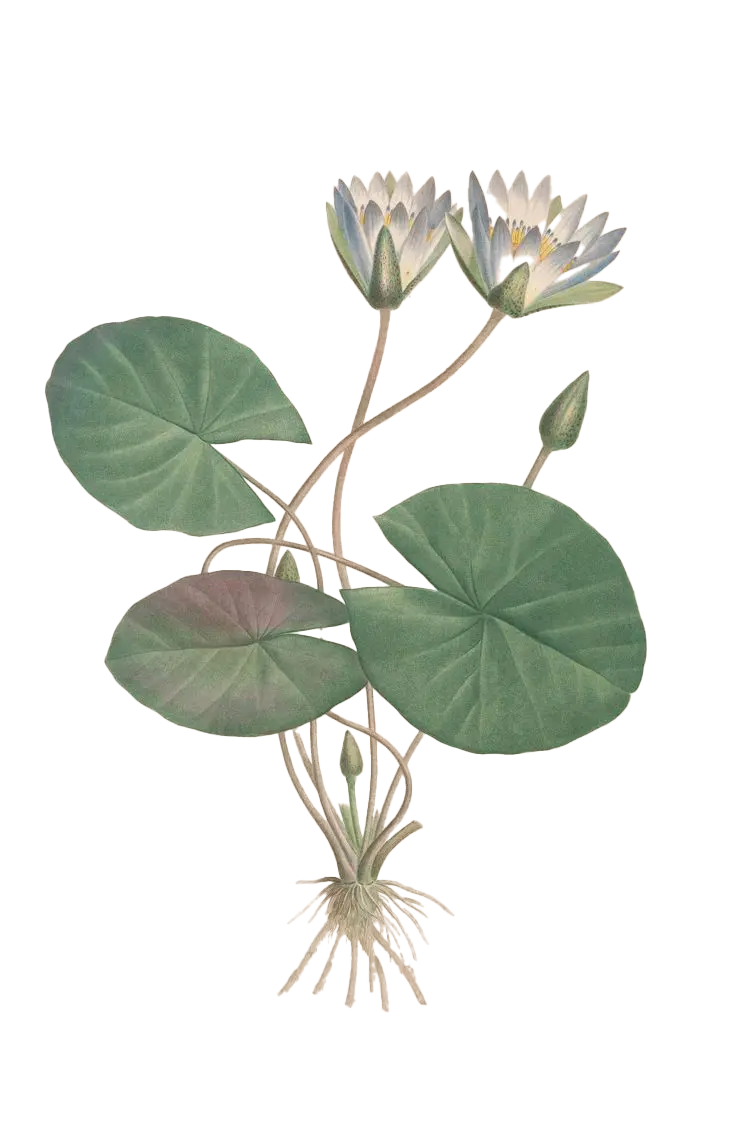
Blue Water Lily botanical illustration

fig. 36 Nymphaea nouchali

There is a moment, somewhere in the long literature of botany, where names begin to matter more than we expect. Nymphaea caerulea — the Egyptian Blue Lotus — and Nymphaea nouchali — the Blue Water Lily — are cousins close enough to share a genus, a color palette, and centuries of human reverence. They are not, however, the same plant, and that distinction is worth sitting with before you go any further.

The Blue Water Lily (Nymphaea nouchali) is a wide-ranging aquatic perennial native to southern and eastern Asia and parts of Africa, where it blooms across still ponds and slow rivers in shades of pale blue to soft violet. Its petals are delicate and pointed, its fragrance subtle — a quieter presence than its Egyptian relative, though no less storied. Where the Egyptian Blue Lotus (Nymphaea caerulea) carries the weight of pharaonic ceremony and Nile-side ritual, the Blue Water Lily has woven itself into the sacred fabric of South Asian, Southeast Asian, and Sri Lankan traditions over thousands of years. It is the national flower of Sri Lanka and Bangladesh — not a small honor for a plant that grows with its roots in mud and its face turned toward the sky.

What both plants share is a quality that seems to draw human attention across every culture that encounters them: the daily ritual of closing at dusk and opening again at dawn, emerging clean from opaque water, rooted in darkness but flowering in light. It is the kind of behavior that invites metaphor whether you intend it or not.

across time

Tradition & Ritual

In the Hindu and Buddhist traditions of South and Southeast Asia, Nymphaea nouchali occupies genuinely sacred ground. The blue lotus or blue water lily is among the most recognized symbols in both traditions — it appears in temple carvings, devotional paintings, and ritual offerings across Sri Lanka, India, Thailand, and beyond. In Sanskrit, it is called nilotpala, the blue lotus, and it is associated with deities including Vishnu and Lakshmi, whose imagery frequently places them standing or seated on lotus blooms. The lotus rising from muddy water became one of the central visual metaphors of Buddhist philosophy: the possibility of awakening arising from the conditions of ordinary, murky human life.

In Ayurvedic and traditional Sri Lankan medicine systems, the Blue Water Lily has long been used ceremonially and medicinally — its flowers and rhizomes incorporated into offerings, ritual baths, and preparations meant to calm the mind and support the body. The flower's association with purity, clarity, and spiritual aspiration made it a natural companion to meditative and devotional practice. Offerings of fresh blue water lily blossoms remain common in Hindu temple ceremonies across South Asia today.

The plant's reach extends into traditional African botanical traditions as well, where related species have been used in ritual contexts. The deeper pattern — aquatic flowering plants as gateways between worlds, between the murky and the luminous — appears with remarkable consistency across cultures that had no known contact with one another. Plants, as it turns out, have their own ways of making themselves remembered.

what it offers

Scientific & Medicine

Modern botanical research has confirmed a number of biologically active compounds in Nymphaea nouchali, including flavonoids, alkaloids, and glycosides. The plant's aerial parts, rhizomes, and seeds have all been subjects of study. Researchers have identified compounds with potential antioxidant, anti-inflammatory, and antimicrobial properties, and traditional claims about the plant's calming and nervine qualities have drawn enough scientific interest to generate a modest but growing body of literature.

Among the alkaloids present in various Nymphaea species, nuciferine and apomorphine-related compounds appear in the research — the same compounds that have attracted attention in studies of Nymphaea caerulea. The concentrations and precise chemical profiles differ between species, which is one reason the distinction between Egyptian Blue Lotus and Blue Water Lily matters practically as well as taxonomically. They are related, they share some chemistry, but they are not interchangeable.

Traditional Ayurvedic texts describe the plant as a cooling, calming herb associated with the mind and the nervous system. Its rhizome has been used in various preparations across South Asian traditions. As always, this entry is informational only — not medical advice, not dosing guidance, not a treatment recommendation. The plant has a long relationship with human bodies; the full dimensions of that relationship are still being mapped.

the old stories

Legends & Myths

The mythology surrounding blue lotus and blue water lily plants is rich enough that separating the two species in folklore is nearly impossible — and perhaps beside the point. Cultures encountered these plants as living presences, not taxonomic categories, and the stories they generated reflect that intimacy.

In Hindu mythology, the god Vishnu is sometimes called Pundarikaksha — lotus-eyed — and the blue lotus is considered one of his sacred emblems. Lakshmi, goddess of prosperity and beauty, is almost invariably depicted with lotus flowers, often blue or pink, and the lotus throne (padmasana) appears beneath deities throughout the tradition. The lotus's daily cycle of closing and submerging at night, then rising and opening at dawn, made it a natural symbol of the sun, of rebirth, and of the soul's capacity to return to clarity after being submerged in the waters of ordinary life.

In Buddhist tradition, the blue lotus specifically (utpala in Sanskrit) became associated with the perfection of wisdom and with Manjushri, the bodhisattva of wisdom, who is sometimes depicted holding a blue lotus. The Lotus Sutra, one of the most influential texts in Mahayana Buddhism, uses the lotus as its central image precisely because of this quality: a flower of extraordinary beauty emerging from conditions that seem to preclude it.

There is also a quieter strand of folklore — found across Sri Lanka and parts of India — in which the Blue Water Lily appears in dream lore and in stories about the boundary between waking and sleeping, between this world and the next. A flower that closes its eyes at night and opens them again in the morning was always going to attract that kind of attention.

from the bear

Bear Originals

We carry the Blue Water Lily as a single smokable herb — and we take the naming seriously, which means being clear about what it is and what it isn't. This is Nymphaea nouchali, the Blue Water Lily, not Nymphaea caerulea, the Egyptian Blue Lotus, which we carry separately as the Egyptian Blue Lotus Flower. Both deserve to be known on their own terms.

The Blue Water Lily brings a gentle, aromatic quality to ceremonial smoke — a floral note that doesn't shout. It's the kind of herb that asks you to slow down, to pay attention to what's subtle, to notice what's happening in the quieter registers of an experience. We frame it within the same ceremonial context we bring to all our herbs: as an invitation to a more intentional relationship with the plant world, not as a novelty or a shortcut.

If you're new to single herbs and curious where to start, our blend guide is a good place to orient yourself, and you're always welcome to reach out with questions. The herb encyclopedia entry for the Egyptian Blue Lotus is worth reading alongside this one — the two plants illuminate each other.

Cautions & Contraindications

The Blue Water Lily (Nymphaea nouchali) has a long history of use in traditional medicine and ceremonial contexts without a well-documented profile of serious adverse effects in healthy adults. That said, some alkaloids present in Nymphaea species may interact with certain medications, particularly those affecting the central nervous system or cardiovascular system, and anyone with relevant health conditions should consult a qualified healthcare provider before use.

As with any herb used by inhalation, smoking carries inherent risks to the respiratory system independent of the herb itself. People who are pregnant, breastfeeding, or managing chronic health conditions should exercise caution and seek professional guidance. We do not offer medical advice, dosing recommendations, or treatment claims — the plants are the elders here, and a little humility about what we don't yet fully understand is always appropriate.
take it home

Buy Blue Water Lily

Pure, organic Blue Water Lily available in our shop.

Shop Blue Water Lily (aka Blue Lotus) · $9.95 →
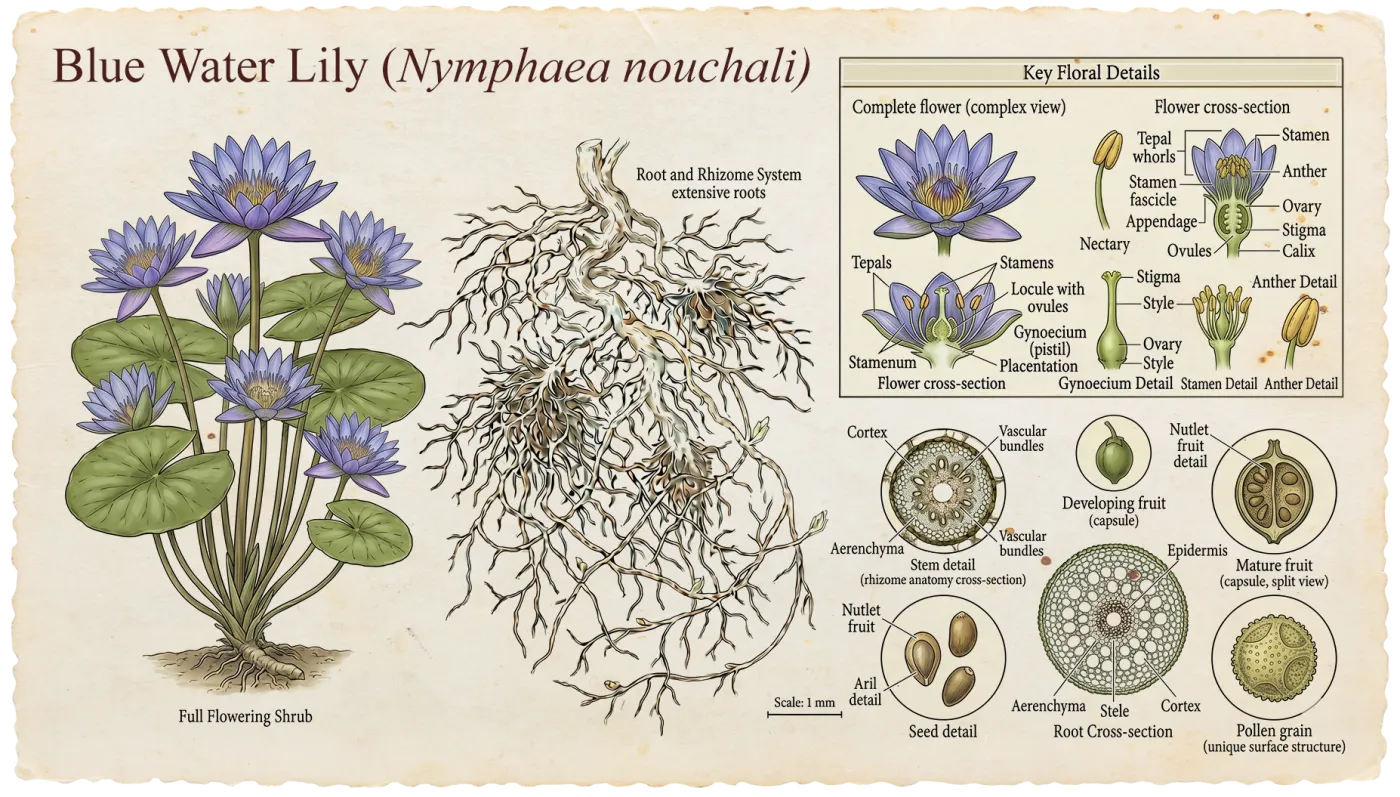
Botanical plate of Blue Water Lily (Nymphaea nouchali)
of

of