
Bear Blend — Celebrating Life Through Ritual
Bear Blend
Sign In Create Account Cart

Spearmint

(Mentha spicata)

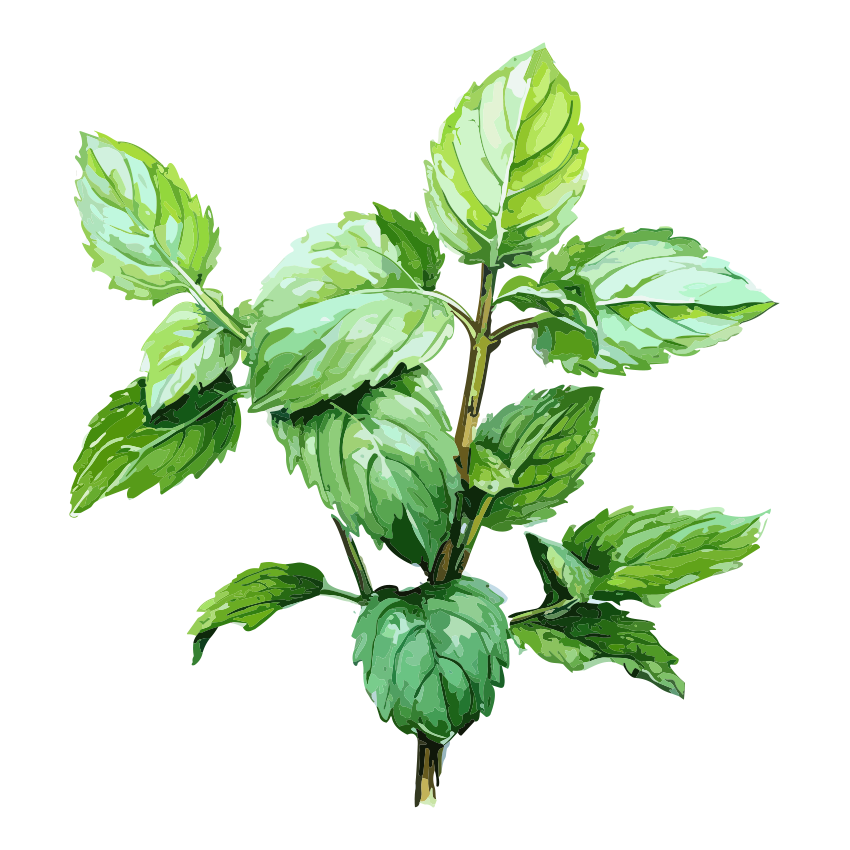
Spearmint botanical illustration

fig. 9 Mentha spicata

Spearmint — Mentha spicata — is the mint that doesn't announce itself with a shout. Where peppermint arrives like a cold front, spearmint comes in through an open window: bright, green, a little sweet, and unhurried. It is one of the oldest cultivated herbs on the planet, a garden escapee that has been crossing borders and finding its way into kitchens, apothecaries, and ceremonial spaces for millennia, usually without being invited and rarely being asked to leave.

The plant itself is a vigorous, almost aggressively optimistic grower — a square-stemmed, lance-leafed sprawler that will colonize a garden bed if you let it, which is its own kind of lesson about persistence. The aromatic compound responsible for its distinctive character is carvone, not menthol (that belongs to peppermint), which is why spearmint tastes rounder, warmer, and more complex — less medicinal cabinet, more summer garden after rain.

As a smokable herb, spearmint brings a clean, cooling quality to blends without the intensity of its more famous cousin. It lightens the character of a smoke, opens the breath, and carries a freshness that feels less like an ingredient and more like a mood.

across time

Tradition & Ritual

Spearmint's ceremonial and culinary history is long enough that it appears in the New Testament — the Pharisees are rebuked for tithing their mint and cummin while ignoring justice, which tells you that mint was valuable enough currency to offer as a temple tithe in first-century Judea. That's not a footnote; that's a measure of cultural weight.

Ancient Greeks strewed spearmint on the floors of their meeting halls and rubbed it onto their banquet tables — part air freshener, part welcome signal, part quiet claim that this was a space worth entering with some dignity. The Romans carried it wherever they went, and since Rome went nearly everywhere, spearmint traveled with the legions into Britain and beyond, where it eventually naturalized so completely that later generations assumed it had always been there.

In Moroccan and broader North African tradition, spearmint tea — made strong, poured high, and sweetened without apology — is not simply a beverage. It is a ceremony of hospitality, a ritual of welcome and trust, a shared moment that anchors social and spiritual life. The act of preparing and offering the tea is as meaningful as drinking it. That ritual logic — that the preparation is part of the medicine — is one Bear Blend recognizes as its own.

In folk traditions across Europe and the Americas, spearmint appeared in sachets meant to invite love and prosperity, tucked into letters, hung above doorways, and carried as a charm for safe travel. It was understood, in the way plant medicine traditions often understand things intuitively before science catches up, that spearmint had something to do with clarity, openness, and the easing of passage.

what it offers

Scientific & Medicine

The primary active compound in spearmint is R-carvone, a monoterpenoid ketone that accounts for roughly 45–70% of the essential oil depending on growing conditions and harvest timing. Carvone is the molecule your nose recognizes as "spearmint" — and interestingly, its mirror-image molecule, S-carvone, smells like caraway seed. Same atoms, different arrangement, completely different sensory experience. The plant kingdom's chemistry is full of moments like that.

Traditional herbalism has long used spearmint for digestive complaints — nausea, bloating, cramping, and general gastrointestinal unease — and contemporary research has begun to sketch in the mechanisms behind that traditional use. Studies suggest that carvone and related compounds may have antispasmodic effects on smooth muscle, which would support spearmint's reputation as a digestive soother. Some preliminary research has also examined spearmint's potential effects on androgen levels and cognitive function, though that work is early and ongoing.

Spearmint also contains rosmarinic acid, limonene, and a range of flavonoids with antioxidant properties. As with most aromatic herbs, the traditional applications — respiratory ease, digestive calm, mental clarity — tend to cluster around the same biological territory that researchers are now beginning to map more precisely. The herbalists got there first, as usual.

As always, this is offered as historical and informational context only — not as medical advice, dosing guidance, or treatment for any condition.

the old stories

Legends & Myths

The Greeks gave spearmint its oldest surviving story, and it is, as so many plant origin myths are, a love story gone sideways. Minthe was a naiad — a freshwater nymph — and a lover of Hades, lord of the underworld. When Persephone discovered the affair, she transformed Minthe into a low, creeping plant, destined to be walked upon forever. Hades, unable to undo the transformation, gave the plant its scent — so that the more Minthe was trampled, the more fragrant she became. It is a strange kind of immortality: the harder the world presses down, the more powerfully the presence asserts itself.

There is something worth sitting with in that myth. Spearmint really does release its scent most fully when crushed. The story may be ancient imagination, but it encoded an accurate observation about the plant's behavior — which is often how plant myths work. They are folk science wearing a costume.

In medieval European herbalism, mint of various kinds was associated with the planet Venus and the element of water, and was considered an herb of memory. Scholars wore mint garlands to sharpen their thinking; students rubbed the leaves on their wrists before examinations. Whether this worked is a matter of reasonable debate, but the association between mint's clarifying scent and mental acuity has persisted across cultures and centuries with remarkable consistency.

from the bear

Bear Originals

Spearmint appears in our Mintz Herbal Ceremonial Blend — a cooler, mentholated variation on the Original Bear Blend that brings a clean freshness to the ceremonial smoke experience. The Mintz line is available as a loose blend, as Rolliez, as herbal cigarettes, and as a Liquid Herbz diffuser in spearmint flavor, among other formats.

We also carry spearmint as a single smokable herb, for those who want to work with it directly — blending it into their own ceremonial practice, pairing it with other herbs, or simply exploring what this plant brings on its own terms. As with everything in our catalog, our Spearmint is ethically sourced, because the integrity of the relationship between you and the plant starts well before it reaches your hands.

In the ritual context we frame around the Mintz blend, spearmint's role is that of the opener — the herb that clears the air, invites a fresh perspective, and makes a little room in the moment for something new to enter. That is not a marketing description; it is what mint has been doing in ceremony and daily life for thousands of years. We are simply making space to notice it.

Cautions & Contraindications

Spearmint is generally considered safe for most adults when used as an aromatic herb, in teas, or in smokable blends at typical amounts. As with any smokable material, combustion produces byproducts, and those with asthma, respiratory sensitivity, or compromised lung function should approach smoking of any kind — herbal or otherwise — with appropriate care.

Some sources note that very large, concentrated amounts of spearmint (particularly in supplement or extract form) may have hormonal effects — specifically, some studies have looked at its potential to reduce androgen levels — though this is not a concern relevant to occasional ceremonial or aromatic use. Pregnant and breastfeeding individuals are generally advised to consult a qualified healthcare provider before using herbal products beyond culinary amounts. If you have a health condition or take medications, a conversation with your healthcare provider before introducing new herbs is always a reasonable step.
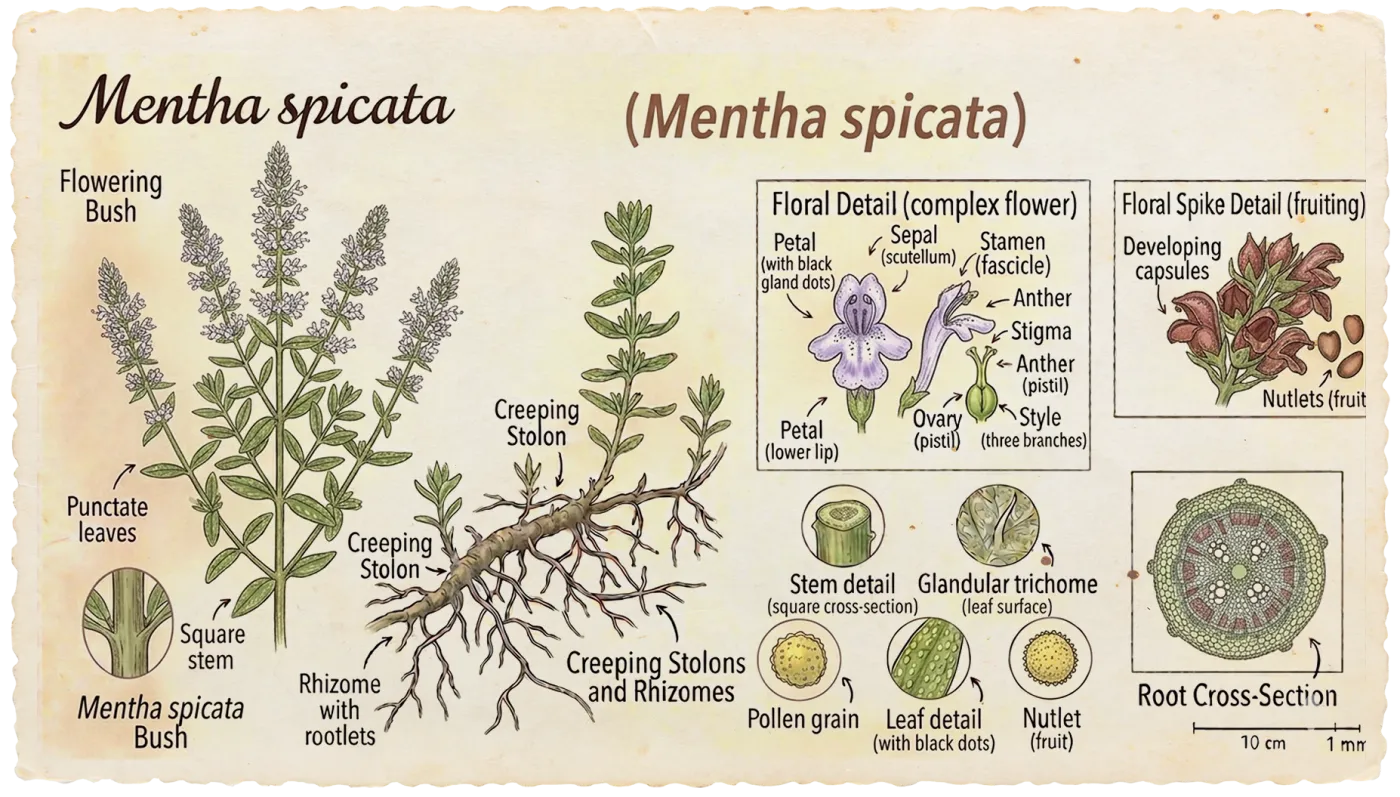
Botanical plate of Spearmint (Mentha spicata)
of

of

cookies & such

We use essential cookies to run the shop (cart, checkout, sign-in) and, with your OK, analytics cookies to understand how folks use the site. See our Privacy Policy.