
Bear Blend — Celebrating Life Through Ritual
Bear Blend
Sign In Create Account Cart

Blue Lotus

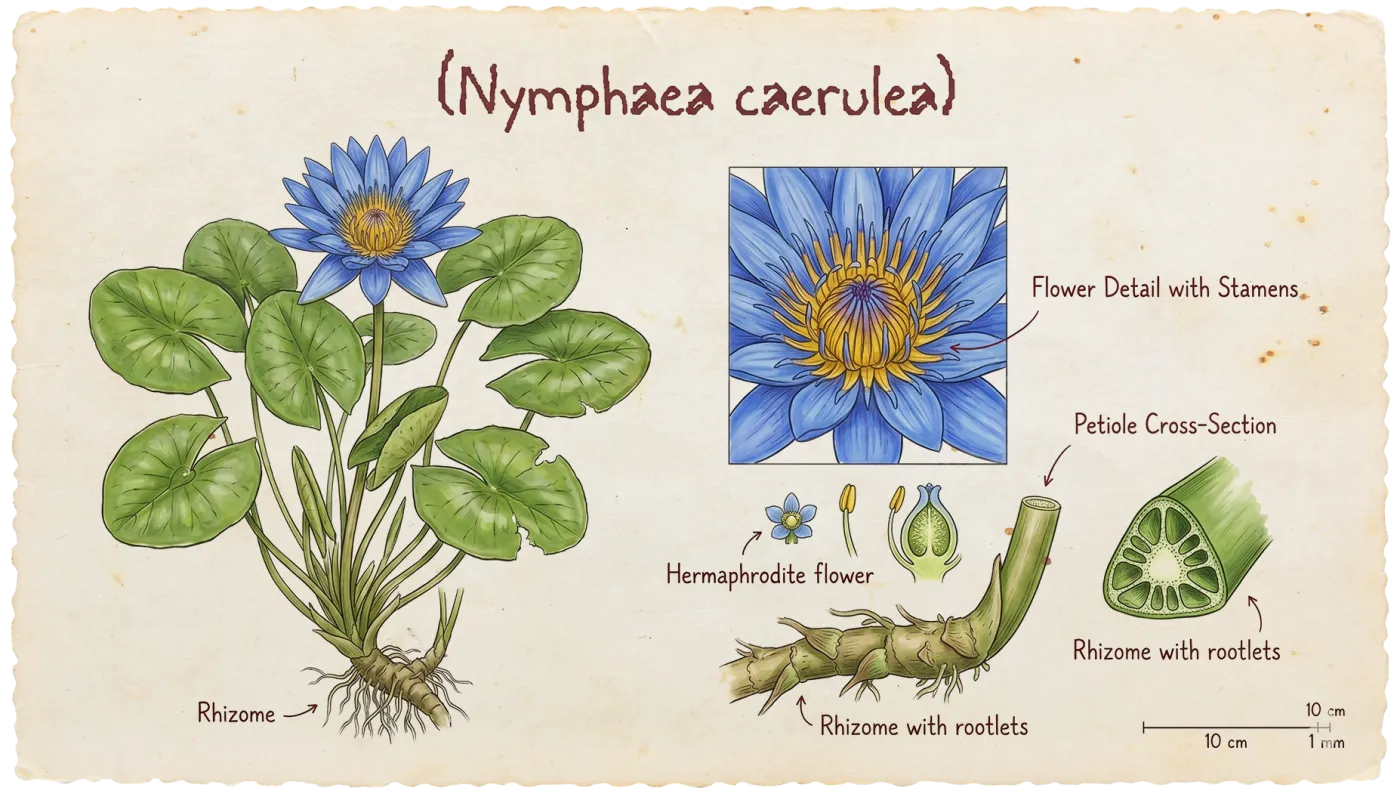
(Nymphaea caerulea)

Blue Lotus botanical illustration

fig. 4 Nymphaea caerulea

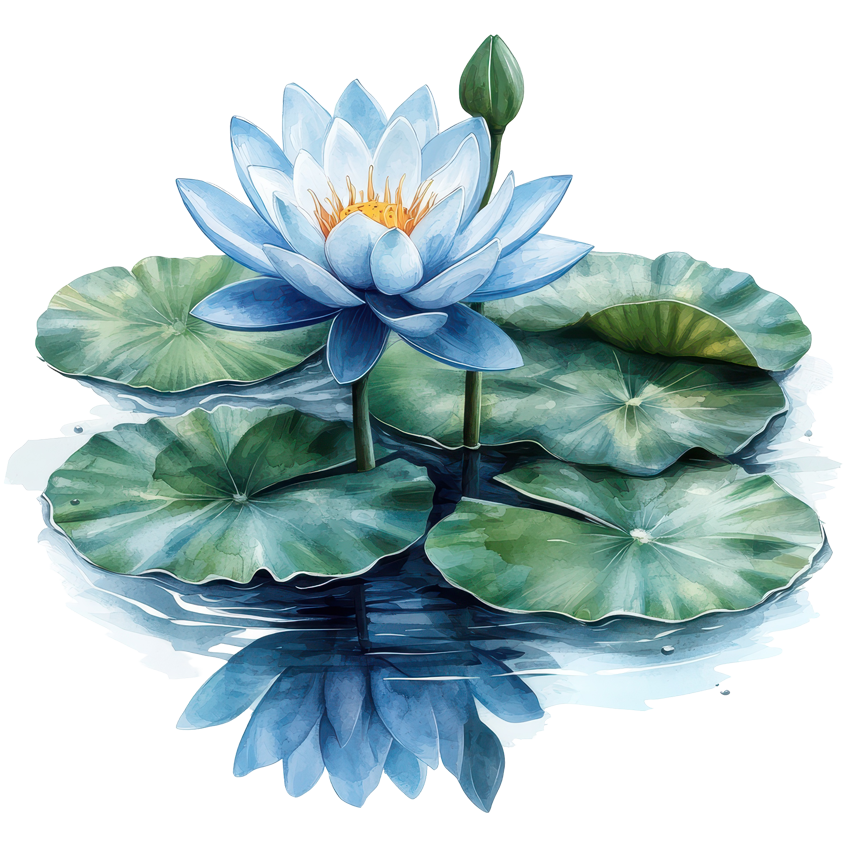
There is a flower that appears in more ancient artwork than almost any other plant on earth — painted onto tomb walls, woven into funeral garlands, floating in the hands of gods — and yet most modern people have never knowingly encountered it. Nymphaea caerulea, the Egyptian Blue Lotus, is a water lily of startling sky-blue petals and a golden center that opens at dawn and closes at dusk, as if it runs on solar time. Which, in a sense, it does: its daily rhythm made it one of the most potent symbols of the sun, rebirth, and consciousness in the ancient world.

It grows from muddy water into something luminous — a metaphor so obvious that humans across multiple civilizations reached for it independently. The plant is native to the Nile Delta and parts of East Africa, and it thrives in still or slow-moving water, rooting in the sediment below while its blooms hover at the surface. That in-between quality — rooted in darkness, flowering in light — is the kind of botanical poetry that tends to attract ceremony.

A quick but important note on identity: the market for Blue Lotus has become muddied (no pun intended) by a widespread case of mistaken — or convenient — identity. Nymphaea nouchali, a purplish relative sometimes called the Blue Star Water Lily, is frequently sold as Blue Lotus or Nymphaea caerulea. The two plants are related but distinct: different alkaloid profiles, different appearances, different histories. If you are sourcing Blue Lotus for ceremonial or intentional use, it matters which one you actually have. True Nymphaea caerulea has pale blue-to-white petals with a distinctly yellow center; N. nouchali tends toward deeper violet-blue with a blue center. We source and sell the real thing — see our Egyptian Blue Lotus — and we think the distinction is worth knowing.

across time

Tradition & Ritual

Ancient Egypt didn't just appreciate Blue Lotus — it was woven into the very architecture of their spiritual life. Depictions of Nymphaea caerulea appear in papyrus scrolls, temple carvings, and the Book of the Dead. Garlands of the flower were found draped over the mummy of Ramesses II, who died around 1213 BCE. The lotus was associated with Nefertem, god of the lotus blossom and of healing, often depicted rising from the flower itself at the moment of creation. In the Egyptian creation myth, the world began when a lotus rose from the primordial waters and the sun emerged from it — making Blue Lotus literally the cradle of existence in their cosmology.

Ritualists and priests used the flower in ceremony, steeped in wine and offered at festivals. There is compelling iconographic evidence — scenes on tomb and temple walls — of Blue Lotus being held to the nose and inhaled, suggesting the ancients were well aware of the flower's subtler qualities and chose to engage them in sacred context rather than casual use. This wasn't recreation; it was technology. Ceremony as a means of crossing a threshold.

Beyond Egypt, Blue Lotus appears in the ceremonial traditions of the Maya, who had their own native water lilies and associated them with the Underworld, vision, and shamanic trance. While not the same species, the parallel reverence across unconnected cultures for the water lily form is one of those patterns in human history that makes you wonder what the plant itself might be broadcasting. Today, Blue Lotus is finding its way back into modern ceremony, meditation practice, and intentional ritual — a quiet return that feels less like a trend and more like a remembering.

what it offers

Scientific & Medicine

Nymphaea caerulea contains two primary active compounds that have drawn the attention of researchers: nuciferine and aporphine. Nuciferine is an aporphine alkaloid also found in the sacred lotus (Nelumbo nucifera) and has been studied for its interaction with dopamine and serotonin receptors. Aporphine itself is a mild psychoactive compound. Together, they are believed to be responsible for the gentle, dream-like, mildly euphoric quality that users of Blue Lotus have reported for millennia — a quality that sits well below the threshold of anything dramatic, closer to a soft brightening of mood and a loosening of mental tension.

Traditional medicine systems in Egypt and across sub-Saharan Africa used Blue Lotus for a range of applications — as an anxiolytic, a sleep aid, and a general tonic. Some traditional uses pointed toward its effects on circulation and digestion. Modern pharmacological research is still early, and it is worth noting the difference between traditional use and clinical validation: the plant has a long empirical track record, but rigorous human trials remain limited. What we do know is that the alkaloid profile of true Nymphaea caerulea is meaningfully different from that of Nymphaea nouchali, which is one of several reasons the species distinction matters beyond mere taxonomy.

Blue Lotus is generally used as a smokable herb, steeped as a tea, or infused into wine — methods with long historical precedent. As always, this is informational context, not medical advice. For a deeper look at the science and lore, our blog post on Egyptian Blue Lotus goes further down the rabbit hole.

the old stories

Legends & Myths

The creation myth of ancient Egypt begins with a lotus. Before the earth existed, there was only the dark, boundless ocean of Nun. From those primordial waters, a single Blue Lotus rose — and from its open petals, Ra, the sun god, was born into the world. This makes Nymphaea caerulea not just a sacred plant in Egyptian mythology but the first thing that ever was. That is a remarkable piece of cultural real estate for a water lily to occupy.

There is also the matter of Homer. In the Odyssey, Odysseus's crew lands on the island of the Lotus-Eaters, where eating the lotus flower causes a blissful forgetting — a loss of the will to return home. Scholars have long debated what plant Homer actually had in mind, and Nymphaea caerulea is among the candidates, given its known mild psychoactive properties and its geographic proximity to the Mediterranean world of the epic. Whether or not the identification is correct, it says something that ancient poets reached for the lotus when they wanted to describe a plant that could dissolve the boundary between ordinary life and something more.

In Buddhist and Hindu iconography, the lotus — often the sacred lotus Nelumbo nucifera, though the symbolism bleeds between species — represents enlightenment, purity, and the capacity of the divine to arise from muddy, difficult conditions. The image of the seated figure rising above murky water on a lotus throne is one of the most enduring visual metaphors in human spiritual history. The Blue Lotus of Egypt shares this symbolic grammar: a plant that roots in darkness and flowers in light, again and again, every morning.

from the bear

Bear Originals

Blue Lotus holds a special place in what we do here. It is one of those herbs that arrives with its own gravitational field — a long trail of ceremony, symbolism, and human reverence that makes working with it feel less like sourcing a botanical and more like continuing a very old conversation. We source true Nymphaea caerulea — the authentic Egyptian Blue Lotus — and we think the integrity of that identification matters. In a market where Nymphaea nouchali is routinely passed off as Blue Lotus, we are deliberate about the distinction, because the plant you work with ceremonially should be the plant you think it is.

Our Egyptian Blue Lotus Flower is available as a smokable single herb — the flower petals and stamens dried and ready for rolling, blending, or brewing. It pairs beautifully with other calming, clarifying herbs and is a natural companion to any reflective or meditative practice. We also carry Blue Water Lily as a clearly labeled separate offering, so you always know exactly what you are working with.

The ritual context we invite around Blue Lotus is simple: slow down, set an intention, and let the plant do what it has apparently been doing for several thousand years. Light something, breathe, and notice what opens. That's the ceremony. It doesn't need to be more complicated than that — though it can be as deep as you want to go.

Cautions & Contraindications

Blue Lotus (Nymphaea caerulea) is generally considered safe for most adults when used in the traditional ways — smoking the dried petals, brewing as a tea, or infusing in wine. However, a few cautions are worth holding:

  • Pregnancy and breastfeeding: There is insufficient safety data for use during pregnancy or while nursing. Out of an abundance of caution, it is best avoided during these times.
  • Sedative medications: Because Blue Lotus may have mild sedative and anxiolytic properties, combining it with prescription sedatives, anti-anxiety medications, or other CNS depressants is not recommended without consulting a healthcare provider.
  • Operating machinery: The mildly relaxing quality of the plant means it is not a great companion to tasks that require sharp alertness.
  • Species integrity: Know what you are actually using. Nymphaea nouchali, frequently mislabeled as Blue Lotus, has a different alkaloid profile and a different safety and effects history. This is not a trivial distinction.

As with any herb, individual response varies. If you have specific health conditions or are on medications, a conversation with a qualified healthcare provider before use is the responsible move. Nothing here constitutes medical advice.
take it home

Buy Blue Lotus

Pure, organic Blue Lotus available in our shop.

Shop Egyptian Blue Lotus Flower — Smokable Herbs · $17.95 →
Botanical plate of Blue Lotus (Nymphaea caerulea)
of

of