Bear Blend — Celebrating Life Through Ritual
Bear Blend
Sign In Create Account Cart

Holy Basil

(Ocimum tenuiflorum)

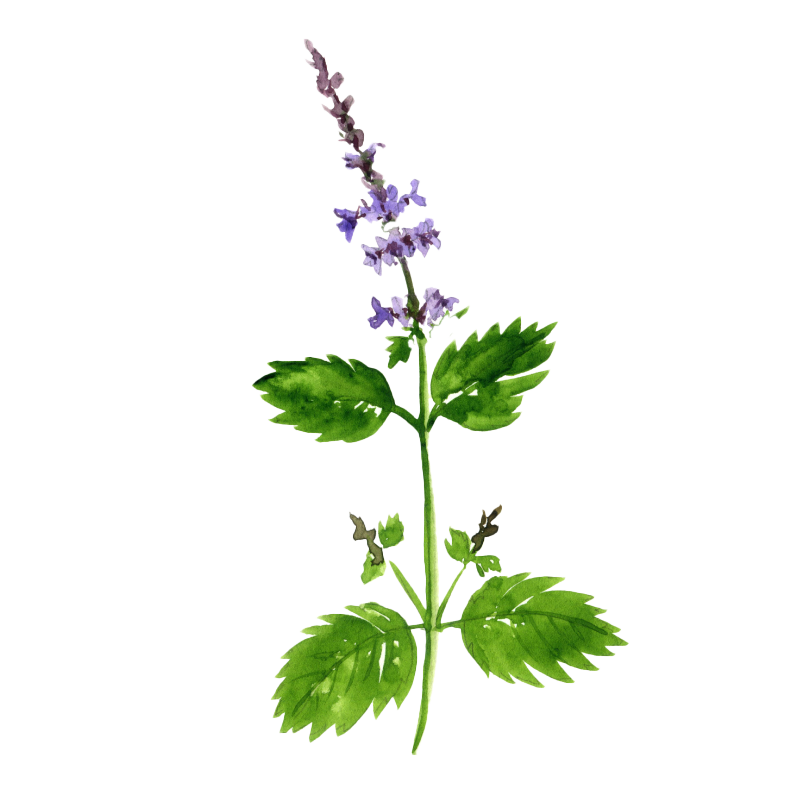
Holy Basil botanical illustration

fig. 18 Ocimum tenuiflorum

There is a plant growing in kitchen gardens across South Asia that has been considered, for at least three thousand years, the most sacred herb on earth. Not merely useful. Not simply fragrant. Sacred — in the way that a threshold is sacred, or a fire lit at the turning of a season. Holy Basil, known in Sanskrit as Tulsi (sometimes spelled Tulasi), carries that designation with a quiet authority that no marketing copy could manufacture. It earned it slowly, over millennia, in temples and households and healing traditions that treated the plant as a living presence rather than a commodity.

Botanically it is Ocimum tenuiflorum (syn. Ocimum sanctum), a member of the mint family, and the family resemblance is legible in its aromatic leaves — though Holy Basil's perfume is something apart: clove-like and peppery, with a green warmth that shifts depending on the variety. There are several cultivars — the purple-leaved Krishna Tulsi, the green Rama Tulsi, the rare Vana Tulsi growing wild in forest margins — each with its own personality, its own slight shift in chemistry. The plant grows as a perennial in the tropics and a tender annual nearly everywhere else, and it has a tendency, noticed by generations of gardeners, to draw the eye and slow the breath without asking permission.

To encounter Holy Basil attentively is to understand why some plants become elders. It is not loud about what it offers. It simply offers it, in the way that a deeply rooted thing offers shade.

across time

Tradition & Ritual

In the Hindu tradition, Tulsi is not metaphorically sacred — it is literally the earthly form of the goddess Lakshmi, consort of Vishnu, and as such it occupies the courtyard of nearly every traditional Hindu household in a dedicated raised planter called a tulsi vrindavan. The morning ritual of watering, circumambulating, and offering incense to the Tulsi plant is performed by hundreds of millions of people daily. This is not historical curiosity; it is living practice. The plant marks the threshold between the domestic and the divine, and its presence in a household is understood to purify the air, the spirit, and the intentions of those within.

The Atharvaveda — one of the four foundational Vedic texts, composed roughly 3,000 years ago — mentions the herb in the context of protection and purification. Leaves are placed on the lips of the dying as a last rite, and garlands of Tulsi are draped on the images of deities. The wood of old Tulsi plants is carved into prayer beads (japa malas), worn close to the skin as a constant, living reminder of the sacred compact between the human and the botanical.

Beyond the Vedic tradition, Tulsi has found its way into Ayurvedic ceremony as a daily ritual herb — taken as a morning tea, burned as incense, or simply held and inhaled as a way of centering the mind before meditation or prayer. The concept it embodies in Ayurveda is rasayana: a practice of rejuvenation that works not through dramatic intervention but through steady, gentle daily presence. The ceremonial logic here is worth sitting with: that the most transformative medicine is the kind you return to every morning, not the kind you take in a crisis.

what it offers

Scientific & Medicine

Modern researchers have found in Holy Basil a pharmacological complexity that supports — without fully explaining — the reverence it has accumulated. The plant is classified in contemporary herbal medicine as an adaptogen: a category of herbs understood to help the body maintain equilibrium under physiological and psychological stress. This is a relatively new framework for a very old observation. The Ayurvedic concept of Tulsi as a daily tonic for resilience and clarity maps remarkably well onto what researchers now describe as HPA-axis modulation — the herb's apparent capacity to influence how the body regulates its own stress-response chemistry.

The active compounds that have drawn the most scientific attention include eugenol (the same compound that gives cloves their distinctive warmth), rosmarinic acid, ursolic acid, and a suite of volatile terpenoids. Eugenol in particular has been studied for its anti-inflammatory and antimicrobial properties. Adaptogens as a category are still an evolving area of research, and it is worth being honest that much of the most rigorous work on Holy Basil remains in early-stage or animal studies; the full picture of how this plant works in the human body is still being drawn.

Traditionally in Ayurveda, Tulsi is used to support respiratory health — it is a classic remedy for coughs, colds, and bronchial congestion — as well as for digestive calm, mental clarity, and what practitioners describe as the harmonization of prana, or vital energy. It is one of the few herbs that sits comfortably in all three Ayurvedic doshas, which is part of why it is recommended as a universal daily practice rather than a targeted treatment. As always, this information is offered as plant lore and context, not as medical advice.

the old stories

Legends & Myths

The origin story of Tulsi in Hindu mythology is a love story, and like most sacred love stories it is also a story about grief, transformation, and the strange mercy of being turned into something rooted. In the most widely told version, Tulsi was a devoted woman named Vrinda whose husband Jalandhar was a demon king made invincible by her own fidelity. When Vishnu, in order to protect cosmic order, disguised himself as her husband and broke the spell of her faithfulness, Vrinda — realizing the deception — cursed Vishnu to become stone (which is why the sacred shaligram stone is considered a form of Vishnu). Out of grief and love, she immolated herself. Vishnu, moved by her devotion, transformed her into the Tulsi plant, promising that she would never leave his side — that every act of worship offered to him would require her presence, that no offering would be complete without her leaves. It is a myth of consecration: the grief of betrayal transformed into the most intimate form of belonging.

There is also a strong folk tradition across India that Tulsi protects against serpents, evil spirits, and the evil eye — that a household with a thriving Tulsi plant is a household under active protection. The plant is said to die when the family it guards is about to face misfortune, an idea that has the interesting practical effect of making people pay close attention to the health of their courtyard plant. Whether or not one holds the literal belief, there is something worth noting in the logic: a culture that teaches you to read the vitality of a plant as a signal of your own household's wellbeing is a culture that has found an elegant way to keep people attentive to the living world around them.

In some folk traditions, Tulsi is never cut after sunset, never touched on certain lunar days, and must be approached with clean hands and a settled mind. These are not arbitrary superstitions — they are protocols for relationship, ways of encoding respect into daily behavior toward a plant that was understood to be listening.

from the bear

Bear Originals

Holy Basil earns its place in our world for the same reason it earned its place in the tulsi vrindavan: not because of what it does in a single dramatic moment, but because of what it offers when you show up to it every day. Our relationship with this herb is framed by the Ayurvedic understanding of it as a daily companion — an adaptogenic ally for the long, slow work of staying grounded and clear-eyed in a world that has a talent for scattering our attention.

We carry Holy Basil as a single smokable herb for those who want to work with it directly and intentionally — to build their own relationship with the plant on their own terms. It pairs naturally with other herbs in our catalog: the calming depth of Mugwort, the gentle ease of Lavender, or the respiratory clarity of Mullein. The smoke is mild and aromatic, carrying that characteristic warm-clove note that makes the ritual of it immediately sensory and present.

The ceremonial context we offer is simple: Holy Basil as a threshold herb. Something to smoke or brew or simply hold before meditation, before a difficult conversation, before the beginning of something new. The Vedic tradition understood that the most powerful rituals are the ones you can sustain — the ones that ask only for your attention and your willingness to return. That feels like the right spirit for it. Browse our full shop to see where it fits into your practice.

Cautions & Contraindications

Holy Basil is broadly considered safe for most adults when used as a food herb, a tea, or a smokable herb in moderate, occasional use. A few cautions are worth holding:

  • Pregnancy and breastfeeding: Tulsi has a traditional reputation as an emmenagogue — an herb that can stimulate uterine activity — and is generally avoided in therapeutic doses during pregnancy. Culinary amounts in food are a different matter, but concentrated use warrants caution. Consult a qualified practitioner.
  • Blood sugar and blood pressure: Some research suggests Holy Basil may have modest effects on blood glucose and blood pressure. If you are managing either condition with medication, it is worth discussing regular therapeutic use with your healthcare provider, as interactions are possible in principle even if not well-documented.
  • Blood clotting: Eugenol, a primary active compound, may have mild anticoagulant properties. People taking blood-thinning medications should be aware of this.
  • Fertility: Some animal studies have suggested that very high doses may affect fertility; the relevance to normal human use is unclear, but it is a noted consideration for those actively trying to conceive.

As with all herbs, the dose, the form, and the individual matter. This is context for your own research and conversation with a healthcare professional — not medical advice.
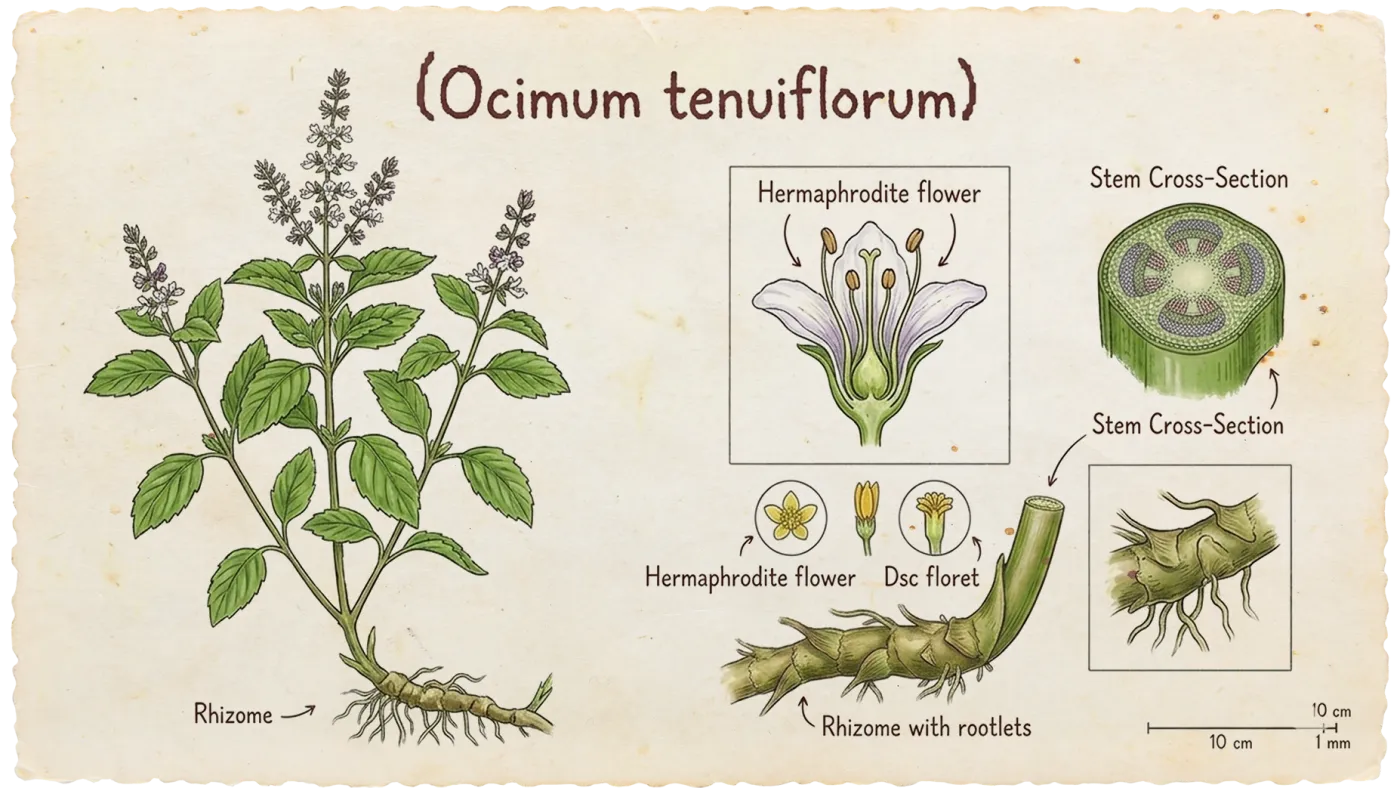
Botanical plate of Holy Basil (Ocimum tenuiflorum)
of

of

cookies & such

We use essential cookies to run the shop (cart, checkout, sign-in) and, with your OK, analytics cookies to understand how folks use the site. See our Privacy Policy.