Bear Blend — Celebrating Life Through Ritual
Bear Blend
Sign In Create Account Cart

Valerian

(Valeriana officinalis)

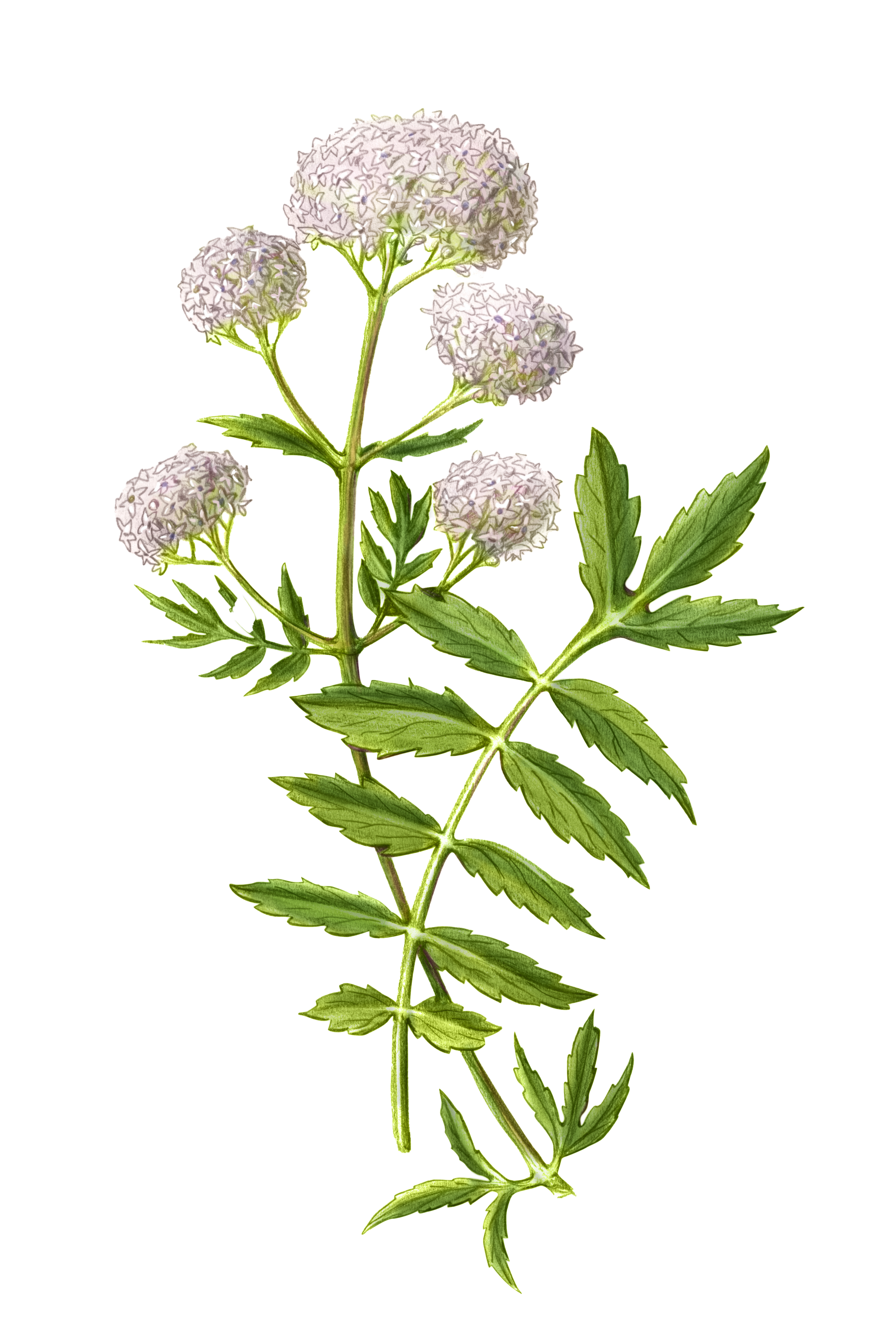
Valerian botanical illustration

fig. 29 Valeriana officinalis

Valerian doesn't ask for your attention — it earns it by smell alone. Crack open a bag of dried valerian root and you'll encounter one of the more assertive aromas in the plant kingdom: earthy, pungent, faintly feral, like damp soil and old forest floor with something deeper underneath. It is not a polite herb. It has been here far too long for politeness.

Valeriana officinalis is a tall, flowering perennial native to Europe and parts of Asia, now naturalized across much of North America. In summer it throws up clusters of small, pale pink to white flowers that smell, charmingly, of vanilla — a complete sensory contradiction to the root below. The root is where the action lives: a dense, fibrous tangle that has been harvested, dried, and put to use for at least two thousand years as one of humanity's most reliable plant allies for rest, stillness, and the unwinding of a wound-up mind.

There is something almost paradoxical about valerian — a plant that smells like the earth asking you to lie down in it, yet carries within that roughness a profound gentleness. It is the elder who has seen enough commotion to know that quiet is the rarest luxury.

across time

Tradition & Ritual

Valerian's ceremonial and medicinal presence stretches back to the physicians of ancient Greece and Rome. Hippocrates described its uses, and Galen prescribed it for insomnia — which means this root was already a known quantity in the Western herb cabinet roughly four centuries before the common era. Its Latin name is thought to derive from valere, meaning "to be strong" or "to be well," and there is something fitting about a plant so singularly committed to the idea of restorative strength through rest.

In medieval European folk tradition, valerian was carried as a protective charm and hung in homes to ward off evil influences. It appeared in the pharmacopoeias of monks and apothecaries alike, tucked into sachets alongside lavender and lemon balm. Some traditions held that valerian could calm disputes between people — that its presence alone softened the edges of conflict. Given what we now understand about how the nervous system mediates our relationship to the world around us, that is less mystical than it sounds.

In Northern European folk practice, valerian was sometimes associated with Midsummer rituals and the liminal, dream-saturated nights around the solstice — times when the boundary between waking and sleeping, between ordinary perception and something wider, was considered thin. It was an herb for crossing thresholds gently. That ceremonial logic still holds: valerian belongs to the rituals of descent, of turning inward, of honoring the dark half of the cycle as necessary and sacred rather than something to be anxiously managed.

what it offers

Scientific & Medicine

Modern research has focused primarily on valerian's relationship to sleep and anxiety, and the picture that emerges is genuinely interesting even if it remains incomplete. The root contains a complex mixture of active compounds — valerenic acid, isovaleric acid, a range of iridoids called valepotriates, and various flavonoids — that appear to interact with the GABA system, the same neurological pathway targeted by many pharmaceutical sedatives. Valerenic acid in particular has been shown in laboratory studies to modulate GABA-A receptors, which helps explain the traditional use of valerian as a calmative without fully resolving how all of its compounds work together.

A curious and well-documented botanical fact: the odor compounds produced when valerian root dries — primarily isovaleric acid — are chemically related to compounds that attract cats in a manner similar to catnip. Cats are genuinely drawn to valerian. Medieval legend held that the Pied Piper of Hamelin carried valerian root in his pockets, not just a flute. The rats, reportedly, followed the smell.

Traditional Western herbalism has long positioned valerian as a nervine — an herb that supports the nervous system — and used it in formulas for sleeplessness, nervous tension, and the kind of circular, repetitive thinking that makes it hard to settle at night. It has also appeared historically in preparations for muscle tension and mild pain. As always, this is offered as botanical and historical context, not medical guidance; anyone with specific health concerns should speak with a qualified practitioner.

the old stories

Legends & Myths

The legend of the Pied Piper, in its older tellings, frequently names valerian as the secret weapon — the root whose smell, stuffed into the piper's coat, drew the rats of Hamelin as surely as any music. Whether the story reflects actual folk knowledge about valerian's attraction to rodents (cats and rats both respond to its compounds) or is simply a convenient narrative detail, it speaks to how deeply the herb had embedded itself in popular imagination by the medieval period: powerful, a little uncanny, and capable of moving creatures against their better judgment.

In some Scandinavian traditions, valerian placed in a wedding garland was said to ward off the envy of elves — a protection against the kind of invisible interference that could unravel good fortune. The herb occupied that interesting folk-magic space between the practical and the protective, between medicine and charm.

There is also a persistent piece of botanical lore worth naming: valerian's genus, Valeriana, has sometimes been confused in historical texts with the spice nard — specifically spikenard, Nardostachys jatamansi, a Himalayan relative with its own ancient ceremonial lineage. The two are distinct plants, but their overlapping aromatic profiles and traditional uses created centuries of cross-pollination in herbal literature, each lending the other a little of its mythology.

from the bear

Bear Originals

Valerian is one of those herbs that earns its place not through glamour but through depth — and that is exactly the kind of plant ally we are drawn to. We carry valerian as a single smokable herb, available for those who want to work with it directly, blending it into their own practice or rolling it into a loose herbal preparation as part of a winding-down ritual.

In the ceremonial frame we bring to all our herbs, valerian belongs to the evening side of the wheel — the descending arc, the inward turn, the moment when the day releases its grip. Smoking herbs has long been a way of marking transitions, of signaling to the body and the nervous system that a threshold is being crossed. Valerian, with its ancient relationship to rest and the loosening of mental tension, is a natural companion to that kind of intentional ceremony.

We source our valerian to the same certified-organic, traceable standard we hold for everything in the catalog — because an herb this old and this respected deserves to arrive clean, without the residue of industrial agriculture complicating the relationship. You can explore our full range of herbal offerings or browse the herb encyclopedia for companion plants that share valerian's ceremonial territory.

Cautions & Contraindications

Valerian is generally considered safe for most healthy adults when used in reasonable amounts, and has a long history of use without serious adverse effects. That said, a few practical notes: some people experience vivid dreams, morning grogginess, or paradoxical stimulation — a restlessness rather than sedation — particularly at higher amounts. This is not universal, but it is real enough to be worth knowing.

Because valerian interacts with the GABA system, caution is warranted for anyone taking pharmaceutical sedatives, anti-anxiety medications, or other CNS depressants, as effects may compound in unpredictable ways. It is not recommended before driving or operating machinery. Pregnant and breastfeeding individuals are generally advised to avoid it, as safety in those populations has not been well established. As with any herb used over an extended period, it is sensible to check in with a qualified healthcare practitioner, particularly if you are managing an existing health condition or taking prescription medications.
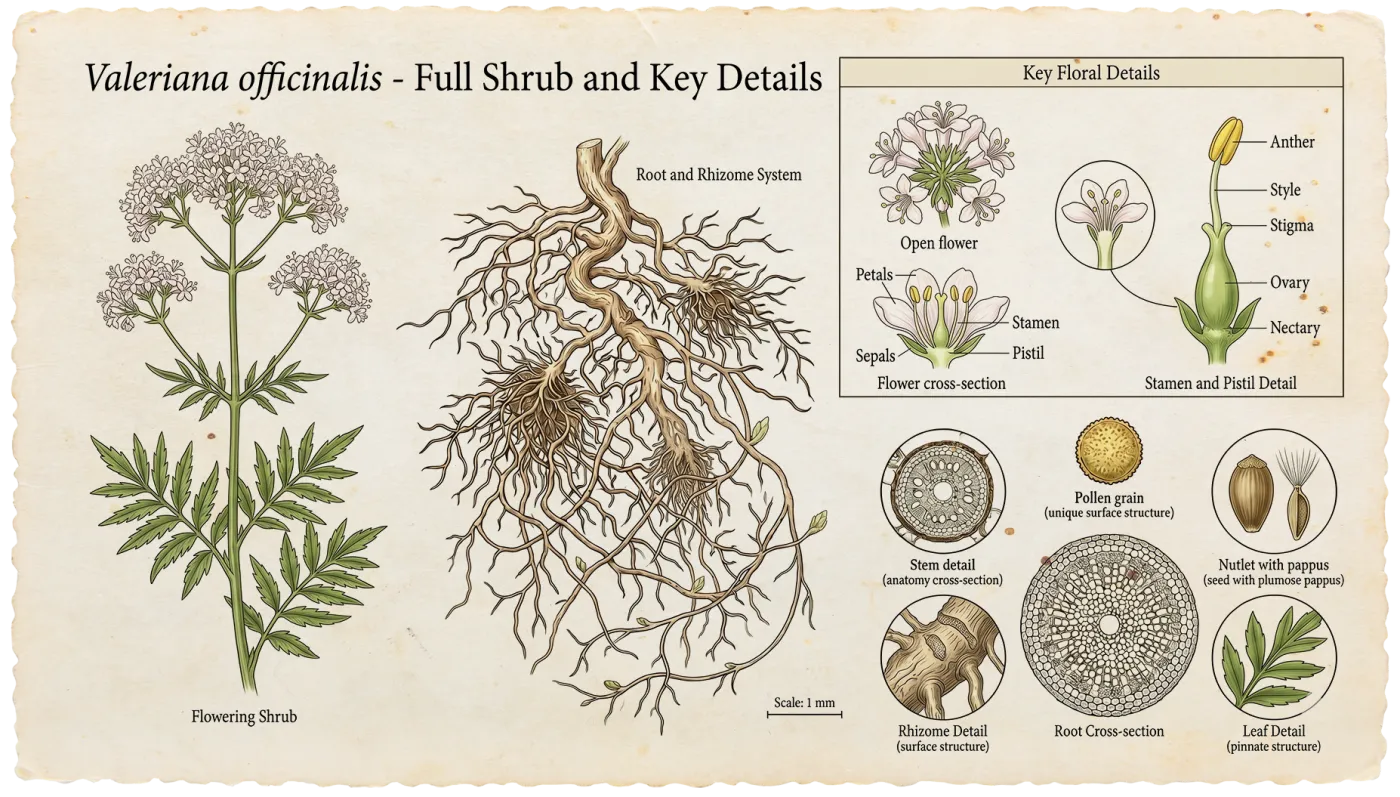
Botanical plate of Valerian (Valeriana officinalis)
of

of

cookies & such

We use essential cookies to run the shop (cart, checkout, sign-in) and, with your OK, analytics cookies to understand how folks use the site. See our Privacy Policy.